

- HOME
- DIVE IN KUSHIMOTO


Diving paradise
at the southernmost tip of Honshu, Japan
KUSHIMOTO
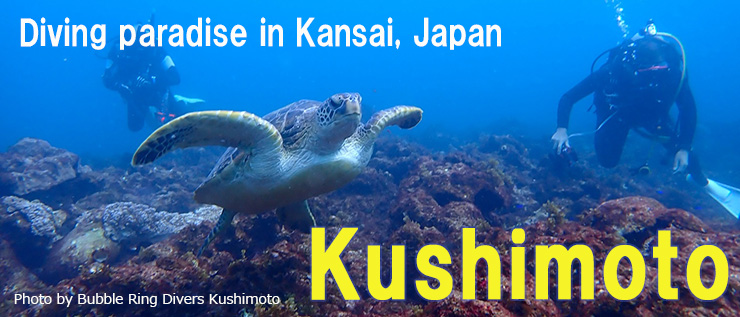
Kushimoto, located in the southern part of the Kii Peninsula, known as "Nanki," is the southernmost point of Honshu (the main island of Japan). Thanks to the counter current from the Kuroshio Current, the seawater temperature is high, and a precious ecosystem with a mixture of subtropical and temperate organisms can be seen underwater. It is the oldest diving area in Nanki, and one of the most historic in the Japanese diving world. We have summarized what diving in Kushimoto is like.
※This information is current as of September 2024.
Overview of Kushimoto
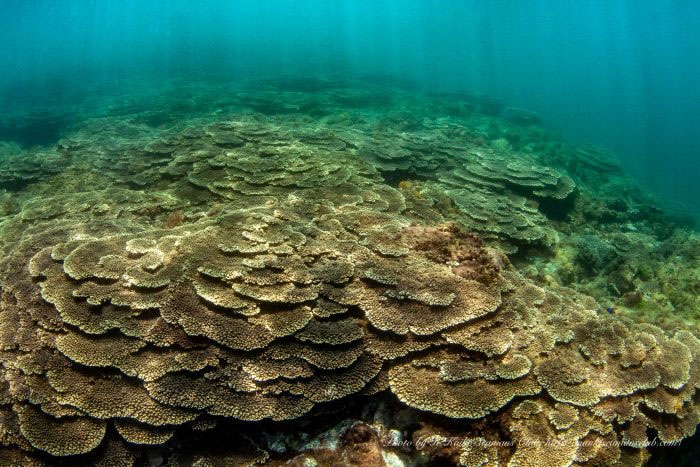
The sea around Kushimoto is registered under the Ramsar Convention because of the coral colonies that are right in front of it.
Photo by Nanki Seaman's Club
Kushimoto is located at the southernmost tip of Japan's largest peninsula, jutting out into the Pacific Ocean from central Honshu. Diving spots are scattered along a coastline stretching over 10 kilometers, from Sumisaki, east of Cape Shionomisaki at the southern tip of the peninsula, to Wabuka, west of Kushimoto Town. There are two main types of diving spots: the inland sea and the open sea. The inland sea spots are popular with divers who enjoy fish watching and macro photography. The open sea spots are dynamic, favored by divers who enjoy the topography and wide-angle photography. Thanks to the influence of the Kuroshio Current, one of the world's largest warm currents, both the open sea and the inland sea maintain consistently high visibility, making them ideal for enjoying the feeling of weightless floating.
Kushimoto is a popular tourist destination thanks to its warm climate and scenic beauty, and there are plenty of accommodations and restaurants. Many diving shops also offer accommodations, making it an ideal environment for diving.
A Day of Diving in Kushimoto
Boat diving is the norm in Kushimoto
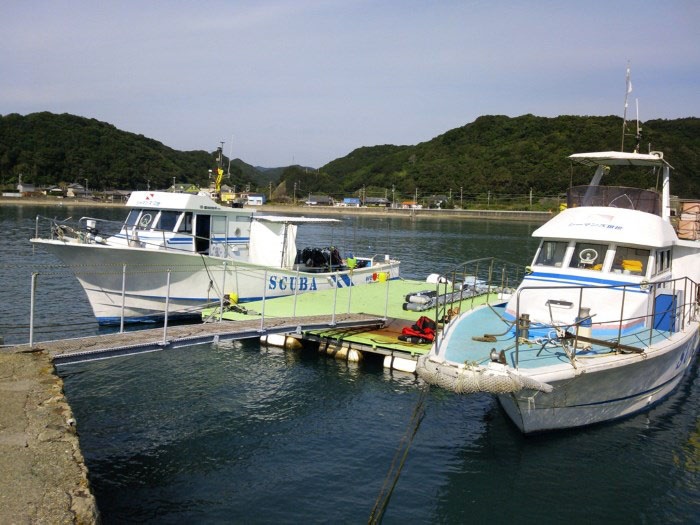
Nanki Seaman's Club's large speedboat
Photo: Nanki Seaman's Club
In Kushimoto, introductory diving and courses involve beach diving, but fun diving is mainly done on boats owned by each dive shop. Most boats have benches on which you can stand your tanks, and you set them up once you're on board. The entry style varies depending on the boat, but the most common is the sitting back roll entry. There are also boats that allow you to enter using a giant stride entry.
Exits are usually made using a ladder. Divers usually hand over their camera and fins and climb out while still carrying their tanks. The ladders on Kushimoto's diving boats are all well designed, making it easy for divers to climb out even while carrying their tanks. Some ladders even make it easy to climb out while wearing fins.
Use a rope when descending into the ocean
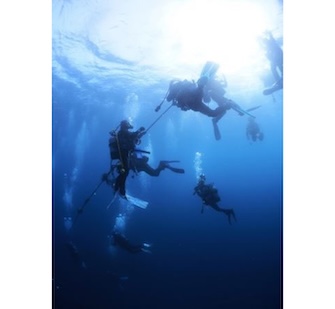
A diver making a safety stop.
Photo by Nanki Seaman's Club
At boat spots, the boat is moored to a buoy or secured with an anchor. Even in inland seas, there can be currents on the surface, and there are currents in the open sea, so be sure to hold on to a rope when descending. Divers who can descend freely without a rope should also listen carefully to their guide's explanation beforehand. Some boats have a safety stop bar installed at a depth of around 3m, but if one does not exist, hold on to the rope and make a three-minute safety stop (or longer in some cases) before surfacing.
A diving guide will show you the highlights of the ocean
In Kushimoto, the dive guide from the shop you use will generally guide you through the ocean. Before diving, you will be briefed on the maximum depth, dive time, course, and highlights, so be sure to listen carefully. In the unlikely event that you get separated from your group, be sure to ask how to reunite.
Dive times and schedules
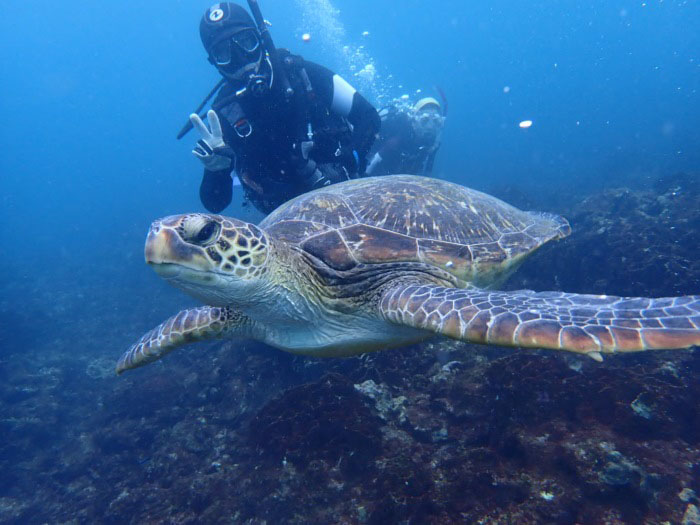
You might even encounter sea turtles and swim with them!
Photo by Bubble Ring Divers Kushimoto
Kushimoto's diving schedule varies depending on the boat departure time. It depends on the dive service and the arrival time of the divers that day, so be sure to check with each store when you arrive. The daily schedule usually consists of two boat dives in the morning and one in the afternoon, but if you wish, you can also go on a fourth dive. Early morning and night dives are often conducted, so be sure to inquire if this is what you prefer.
Dive times vary depending on the depth of the dive site, with 40-50 minutes being the norm, but at deeper depths, dive lasts about 30 minutes,. You can return to the store for a surface rest between dives, which allows you to use the restroom or change camera batteries.
Seasonality
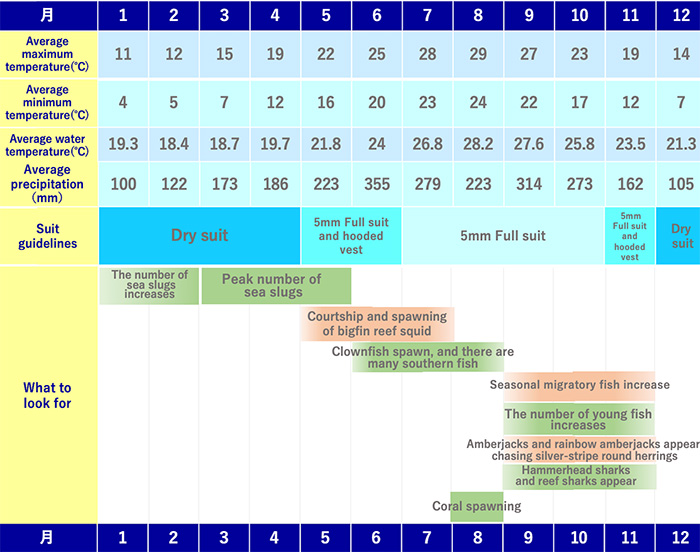
Material provided by Nanki Seamen's Club
In recent years, global warming has progressed not only in Japan but around the world, and it is said that Kushimoto also tends to have higher average air and water temperatures. However, the climate is generally warm even in winter, and unless there is a strong north wind, the sea conditions are calm. From around spring, when the air and water temperatures rise, the number of things to see in the sea increases, and September to November is the best diving season, barring a typhoon. In addition, during the period when shrimp net fishing is closed, a spot called "Ando's Nose" opens for a limited time. This period coincides with the best season, which lasts for about three months from around September, so why not aim to go diving during that time?
Dive sites
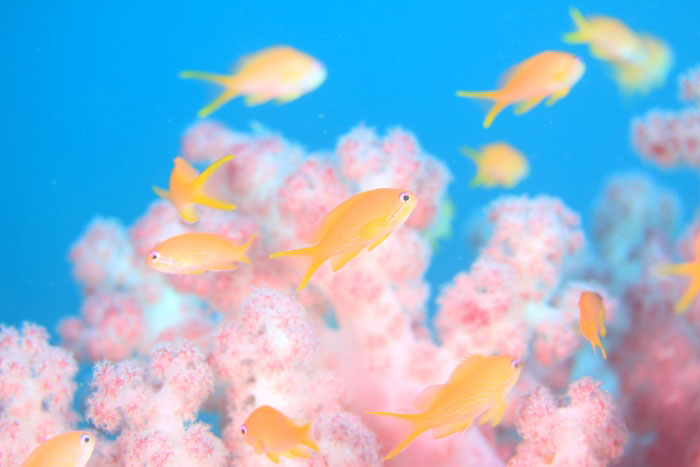
Goldfish anthias swarming among beautiful soft corals.
Photo by Bubble Ring Divers Kushimoto
Kushimoto is located at the southern tip of the Kii Peninsula, and because it is subject to ocean currents (and sometimes the Kuroshio Current), the visibility is usually exceptional, allowing you to enjoy the blue underwater scenery. Diving spots are roughly divided into the "open sea" and "inland sea," and we will introduce the main spots for each here.
Open sea
Asaji
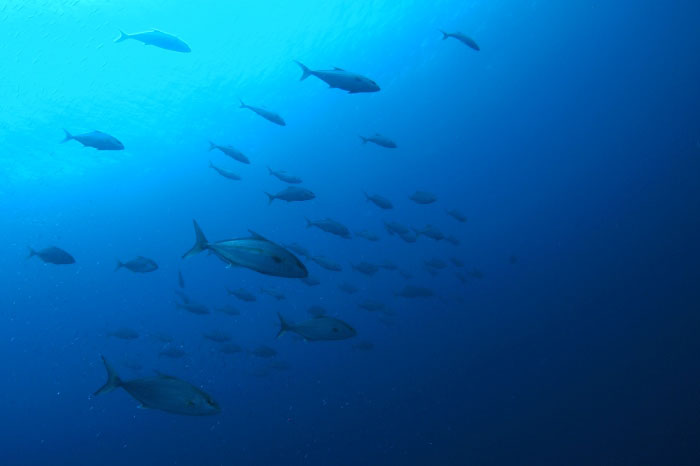
A formation of amberjack charging into the blue ocean.
Photo by Nanki Seaman's Club
This is a typical open sea spot, about 20 minutes by boat from the Kushimoto area, where the Nanki Seaman's Club is located. There are two buoys on a vast rock that rises from a depth of more than 30m, and there are various ways to choose your course. Schools of silver-ringed herrings gather here before summer, and migratory fish such as amberjack and rainbow amberjack come in formation to target them. If you're lucky, you might even see hammerhead sharks and reef sharks pass right in front of you!
Tounooki(Off the coast of the tower)
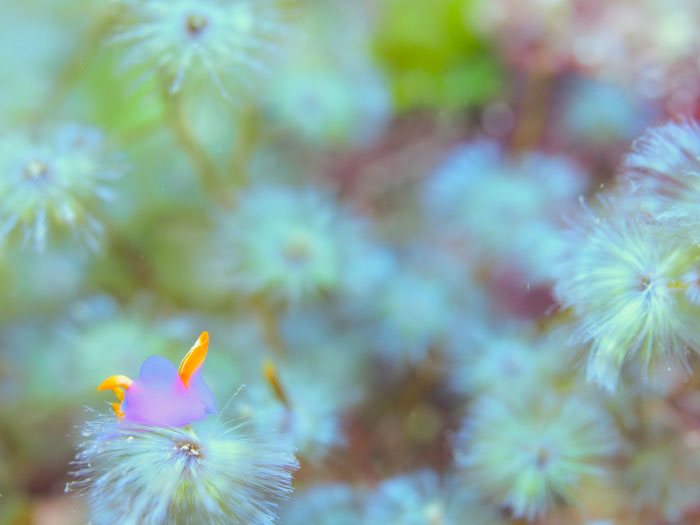
A purple sea butterfly(Sagaminopteron ornatum) on a shining green Sporochnus dotyi
Photo by Nanki Seaman's Club
This diving spot is located about 15 minutes by boat from the Kushimoto area, off the coast of a cape with a tower, hence its name. Sporochnus dotyi, which was given the Japanese name Kujakukeyari after specimens collected in Kushimoto, grows in grassland-like colonies on the seabed at a depth of around 20m. While it's rare to find a perfect opportunity like the one in the photo above, this spot is recommended for those who want to capture a variety of photos of Sporochnus dotyi.
inland sea
Sumisaki
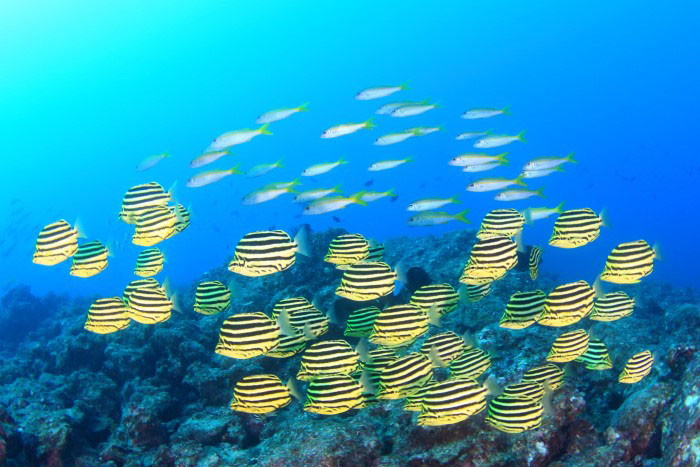
A two-colored boxfish in yellow and black. There's also a red goatfish at the back of the school!
Photo by Bubble Ring Divers Kushimoto
The cape just off the coast of Kushimoto Port heading towards Cape Shionomisaki is called "Sumisaki," and its waters include diving spots such as "Sumisaki," "Bizen," and "Glass World." Sumisaki is the closest, less than 10 minutes by boat from Kushimoto Port. Large rocks are scattered about 5 to 25 meters deep, and several buoys have also been installed, allowing for a variety of diving routes. The largest rock is also known as "Kagokaki no Ne," and schools of boxfish stand out against the blue sea. In early summer, you can see bigfin reef squid spawning, and in summer, green sea turtles can also be seen.
Bizen
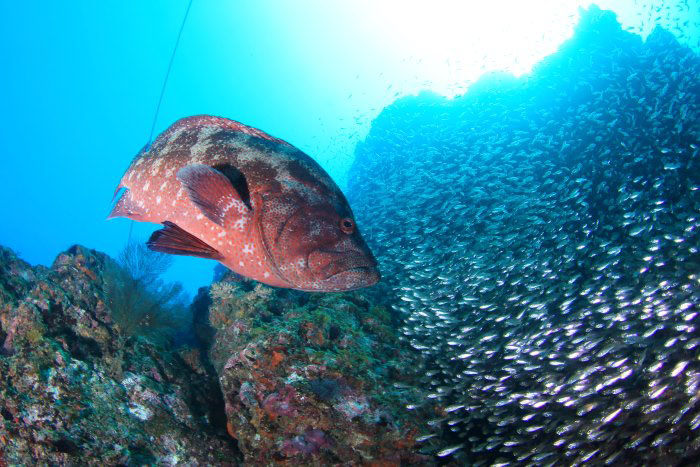
There's also the photogenic Reef with red spotted groupers
Photo by Bubble Ring Divers Kushimoto
Just south of Sumiyoshi are roots of various sizes scattered across the seabed, and here too you can make a variety of dives. You can also drift dive from Bizen to Sumiyoshi, or vice versa.
In Bizen, there are areas where grouper fish hide among black spotted coral, and large grouper fish can also be found lurking. There are also many creatures popular with fish-watching and macro photography divers, such as the screw-legged goby and scalloped horn goby in the sandy areas, and the flat-legged shrimp in the rocky areas! This is a spot you will never get bored of, no matter how many dives you do.
Glass world
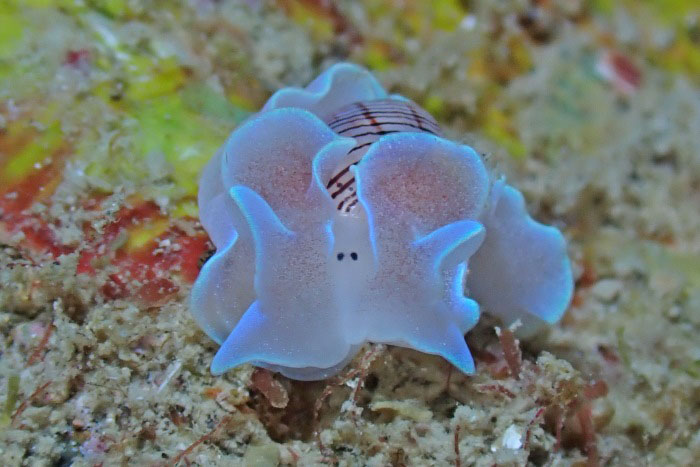
We also saw the adorable sea slug, the Misugai!
Photo / Kushimoto Diving Center
Just over 10 minutes by boat one way, south of Bizen. The spot's name, "Glass," is an abbreviation of "Good Wrasse" (lots of wrasses). Heading west of the buoy, you'll find schools of wrasses swimming in the scree at a depth of about 15m, where they repeatedly spawn, making for a spectacular sight. You may also spot schools of boxfish and butterflyfish. East of the buoy are two tall roots where you can find a variety of creatures, from tengu fish to jawfish and sea slugs, perfect for macro photography. When the tide is in, schools of amberjacks may also come by.
Nakagurumi
Located at the very back of the bay, this is the closest spot to the port, just 3 minutes away. The shallow sand is dotted with coral roots, and on a sunny day it looks like a southern island. There are many fish and the water is shallow, so it can be enjoyed by beginners and veterans alike.
Isuzumisho
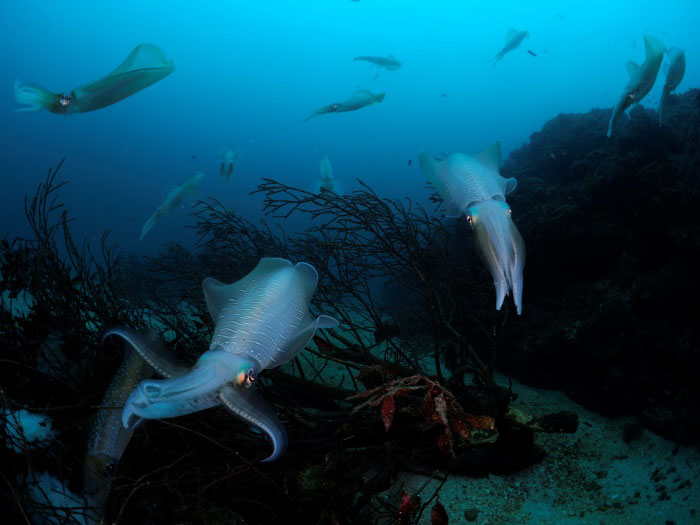
The spawning of bigfin reef squid is also a highlight from June to August.
Photo by Nanki Seaman's Club
Located in front of the northern coast of Kushimoto, the sandy area is 17-18m deep and is dotted with large and small coral roots. On clear days, you can enjoy a tropical landscape reminiscent of Okinawa. In early summer, you can see bigfin reef squid spawning, and around August, large schools of butterflyfish can be seen. There are also various sea slugs along the walls. There is plenty to see, with large groupers hiding deep within the roots and sea turtles perched on top of them!
Diving shop
*Please note that not all diving shops on the list have English speaking staff.
*Please choose the diving shops at your own risk. We’re not responsible for any accidents / troubles.
Access to Kushimoto
You can access Kushimoto from either Osaka or Nagoya/Yokkaichi. There are several stations near the diving shop in Kushimoto, including Kushimoto Station on the JR Kisei Main Line, so you can get there by train, or by car or rental car. From Tokyo, another option is to take an overnight express bus to Katsuura and then transfer to a train.
By train
To get to JR Kushimoto Station, take the Kuroshio limited express train from Shin-Osaka, which takes just 3.5 hours. From Nagoya, you can also head to Shingu Station and change to the limited express train there. There are many diving shops that will pick you up and drop you off at the station at a specified time, so be sure to inquire.
By car
From Osaka, get off at Susami Minami IC on the Kisei Expressway and head south on National Route 42 towards Kushimoto. Just head straight for the diving shop you will be using. The journey takes about 3 hours from Osaka and about 4 hours from Nagoya.